MRA running on DMD
-

Folks, I have been using MRA and DMD2 app in parallel on a DMD T865-X device for several years now and have gained some experience:
-
DMD hardware is excellent manufactured for hard use in offroad terrain. DMD2 app ist developed to support offroad driver in best way - following TRACKS. And the included maps contains colour coded offroad pathes, to suggest if it's easy to drive or hard stuff.
-
The developer is going to add more and more ROUTE capabilities for navigation onroad.
-
MRA and MyRoute-App are the best apps I know to support navigation in onroad terrain, plan round tours by 2 clicks and support long distance traverlers. With the function to convert a route into track and vice versa - and navigate with instructions by both - that's grat stuff and unique!
But for offroading, it's not at the same level as DMD2 app. Fine for me - I use for each approach the best tool... -
Because DMD hardware is based on Android, this was the reason to decide for, and to use both apps (DMD2 and MyRoute-App) parallel on the same device.
Onroad to the entry point of the funny offroad stuff - navigated by MyRoute-App.
Then, switched the app to DMD2 for the pure offroad.
Funny thing: you can run both parallel, feeded by same gpx file - and switch to what do the best job in the moment. -
If you plan a route in MRA and transfer to any other navigation device/-app, then the rout may not the same - based on used maps and differnet algorithm. This can't be changed.
-
all navigation device/-app (in meantime also TomTom and Calimoto) deal with GPX files, because a file with such a data structure (founded by company Topografix) became standard. That files are readable by human and each text editor, because its a simple XML format. But such a file must be in a dedicated structure!
Easy said: -
it can contain a track with several trackpoints, defined in the file by <trk> and <trkpt>.
Check it by yourself - it's easy -
- each device/app will use it as it is (no interpretation nor calculation) and will draw a line over a map.
-
Such a file can contain a route with several routepoints, defined in the file by <rte> and <rtept>.
-
- each device/app will use it, will calculate a route from one point to the next point, by using allowed streets, and will then draw a line over a map.
That's the reason why same route differs from one to another device/app!
- each device/app will use it, will calculate a route from one point to the next point, by using allowed streets, and will then draw a line over a map.
-
And such a file can contain Points of Interest (POI), defined in the file by <wpt> (called waypoint).
-
A route planned in MRA must contain min. 2 route points (start and end); can contain more; can contain shaping points and via points.
Different devices/apps may have not the same point type and may have different names for it -
A route planned in MRA can contain POI (Hotels, Gas stations, Supermarkets). But they are only visible on the map - they are not route points!
If you save such a route in MRA as a gpx file - p.e. gpx 1.1 (track, route, POI), then: -
- tracks, trackpoints will be entered by MRA into this file as <trk>,<trkp> TRACK, TRACKPOINT
-
- routes, routepoints will be entered by MRA into this file as <rte>, >rtept> ROUTE, ROUTEPOINT
-
- POI will be entered by MRA into this file as <wpt> WAYPOINT
-
- that's the irritation - but it's GPX-Standard conform!
If you then import such an MRA generated gpx file into DMD2 app, you will see differences:
-
DMD2 app was originally designed as app, to display TRACKS. Means: only a track line will be drawn on the map. And the rider must follow this line by themself!
In meantime, DMD2 app can guide you (by symbol and speach) also based on a track (like MyRoute-App too). -
By this import routine, it's also possible to load routes. But (like as for tracks), route points will not be displayed (only used to calculate the route).
-
If there are (coming from MRA) POI in the gpx file, then DMD2 app will interpret them as Waypoints <wpt> - strictly following the GPX-Standard!
-
If you place in MRA clever POI along your route - and export as gpx file. The DMD2 app displays them also on the map. It's not the same as in MyRoute-App...
DMD developers ae currently working, to enhance the DMD2 app for better operating with routes.
And they are going to develop a web based routeplanner (like MRA). So the disadvantages for onroad/routes will be eliminated next time! -
-

Nice overview @Guzzist!
I’d be really happy if DMD became available on iOS as well. Unfortunately, at the moment it’s only available for Android.
-
@Marinus-van-Deudekom said in MRA running on DMD:
there are limitations to what a DMD can do with an MRA exported file. For starters the DMD app uses OSM while MRA uses Here.
That's definitely not the main issue.
I've been on the DMD forum (Discord server) for quite a while now and see many postings like "I created a route with MRA, but it doesn't work well with DMD, so the devs have to investigate and fix it".
If you take a closer look, it's most often about misunderstanding different concepts and terms.I had a long and exhausting debate here on this forum, and I will never crawl into this rabbit hole again, but 99% of these misunderstandings come from the different usage of "waypoint" in MRA versus DMD/GPX.

@Martin-Wilcke said in MRA running on DMD:
99% of these misunderstandings come from the different usage of "waypoint" in MRA versus DMD/GPX.
Do you care to explain this difference? What does a waypoint do different in DMD than what it does in MRA? In the end they just shape a route. I think most difference are (just like with any native device) caused by routing settings not being equal between the planner and the device (or DMD software in this case). The beauty of MRA is (amongst others) that a native MRA route applies the planner settings on the navigation app.
-
Folks, I have been using MRA and DMD2 app in parallel on a DMD T865-X device for several years now and have gained some experience:
-
DMD hardware is excellent manufactured for hard use in offroad terrain. DMD2 app ist developed to support offroad driver in best way - following TRACKS. And the included maps contains colour coded offroad pathes, to suggest if it's easy to drive or hard stuff.
-
The developer is going to add more and more ROUTE capabilities for navigation onroad.
-
MRA and MyRoute-App are the best apps I know to support navigation in onroad terrain, plan round tours by 2 clicks and support long distance traverlers. With the function to convert a route into track and vice versa - and navigate with instructions by both - that's grat stuff and unique!
But for offroading, it's not at the same level as DMD2 app. Fine for me - I use for each approach the best tool... -
Because DMD hardware is based on Android, this was the reason to decide for, and to use both apps (DMD2 and MyRoute-App) parallel on the same device.
Onroad to the entry point of the funny offroad stuff - navigated by MyRoute-App.
Then, switched the app to DMD2 for the pure offroad.
Funny thing: you can run both parallel, feeded by same gpx file - and switch to what do the best job in the moment. -
If you plan a route in MRA and transfer to any other navigation device/-app, then the rout may not the same - based on used maps and differnet algorithm. This can't be changed.
-
all navigation device/-app (in meantime also TomTom and Calimoto) deal with GPX files, because a file with such a data structure (founded by company Topografix) became standard. That files are readable by human and each text editor, because its a simple XML format. But such a file must be in a dedicated structure!
Easy said: -
it can contain a track with several trackpoints, defined in the file by <trk> and <trkpt>.
Check it by yourself - it's easy -
- each device/app will use it as it is (no interpretation nor calculation) and will draw a line over a map.
-
Such a file can contain a route with several routepoints, defined in the file by <rte> and <rtept>.
-
- each device/app will use it, will calculate a route from one point to the next point, by using allowed streets, and will then draw a line over a map.
That's the reason why same route differs from one to another device/app!
- each device/app will use it, will calculate a route from one point to the next point, by using allowed streets, and will then draw a line over a map.
-
And such a file can contain Points of Interest (POI), defined in the file by <wpt> (called waypoint).
-
A route planned in MRA must contain min. 2 route points (start and end); can contain more; can contain shaping points and via points.
Different devices/apps may have not the same point type and may have different names for it -
A route planned in MRA can contain POI (Hotels, Gas stations, Supermarkets). But they are only visible on the map - they are not route points!
If you save such a route in MRA as a gpx file - p.e. gpx 1.1 (track, route, POI), then: -
- tracks, trackpoints will be entered by MRA into this file as <trk>,<trkp> TRACK, TRACKPOINT
-
- routes, routepoints will be entered by MRA into this file as <rte>, >rtept> ROUTE, ROUTEPOINT
-
- POI will be entered by MRA into this file as <wpt> WAYPOINT
-
- that's the irritation - but it's GPX-Standard conform!
If you then import such an MRA generated gpx file into DMD2 app, you will see differences:
-
DMD2 app was originally designed as app, to display TRACKS. Means: only a track line will be drawn on the map. And the rider must follow this line by themself!
In meantime, DMD2 app can guide you (by symbol and speach) also based on a track (like MyRoute-App too). -
By this import routine, it's also possible to load routes. But (like as for tracks), route points will not be displayed (only used to calculate the route).
-
If there are (coming from MRA) POI in the gpx file, then DMD2 app will interpret them as Waypoints <wpt> - strictly following the GPX-Standard!
-
If you place in MRA clever POI along your route - and export as gpx file. The DMD2 app displays them also on the map. It's not the same as in MyRoute-App...
DMD developers ae currently working, to enhance the DMD2 app for better operating with routes.
And they are going to develop a web based routeplanner (like MRA). So the disadvantages for onroad/routes will be eliminated next time!
@Guzzist said in MRA running on DMD:
Funny thing: you can run both parallel, feeded by same gpx file - and switch to what do the best job in the moment.
I have been wondering if this was possible, just maid a small test on it an that without problems -not mutch driving in DK this time of year.. ️
️
I have sendt an request to Johny Pear if it was possible to make a setting so the planner will be disablet and only Dashboard/homepage was active, then only on nav system was loading the system and all other good stuff was active, OBD, Tire Press, apps .....
Regarding shaping points -Johny wrote to me ..
"Sorry but we will never support shaping points, as I said, I do not agree with that use case. If you need/want shaping points then use GPX Tracks and not routes" -
-
Folks, I have been using MRA and DMD2 app in parallel on a DMD T865-X device for several years now and have gained some experience:
-
DMD hardware is excellent manufactured for hard use in offroad terrain. DMD2 app ist developed to support offroad driver in best way - following TRACKS. And the included maps contains colour coded offroad pathes, to suggest if it's easy to drive or hard stuff.
-
The developer is going to add more and more ROUTE capabilities for navigation onroad.
-
MRA and MyRoute-App are the best apps I know to support navigation in onroad terrain, plan round tours by 2 clicks and support long distance traverlers. With the function to convert a route into track and vice versa - and navigate with instructions by both - that's grat stuff and unique!
But for offroading, it's not at the same level as DMD2 app. Fine for me - I use for each approach the best tool... -
Because DMD hardware is based on Android, this was the reason to decide for, and to use both apps (DMD2 and MyRoute-App) parallel on the same device.
Onroad to the entry point of the funny offroad stuff - navigated by MyRoute-App.
Then, switched the app to DMD2 for the pure offroad.
Funny thing: you can run both parallel, feeded by same gpx file - and switch to what do the best job in the moment. -
If you plan a route in MRA and transfer to any other navigation device/-app, then the rout may not the same - based on used maps and differnet algorithm. This can't be changed.
-
all navigation device/-app (in meantime also TomTom and Calimoto) deal with GPX files, because a file with such a data structure (founded by company Topografix) became standard. That files are readable by human and each text editor, because its a simple XML format. But such a file must be in a dedicated structure!
Easy said: -
it can contain a track with several trackpoints, defined in the file by <trk> and <trkpt>.
Check it by yourself - it's easy -
- each device/app will use it as it is (no interpretation nor calculation) and will draw a line over a map.
-
Such a file can contain a route with several routepoints, defined in the file by <rte> and <rtept>.
-
- each device/app will use it, will calculate a route from one point to the next point, by using allowed streets, and will then draw a line over a map.
That's the reason why same route differs from one to another device/app!
- each device/app will use it, will calculate a route from one point to the next point, by using allowed streets, and will then draw a line over a map.
-
And such a file can contain Points of Interest (POI), defined in the file by <wpt> (called waypoint).
-
A route planned in MRA must contain min. 2 route points (start and end); can contain more; can contain shaping points and via points.
Different devices/apps may have not the same point type and may have different names for it -
A route planned in MRA can contain POI (Hotels, Gas stations, Supermarkets). But they are only visible on the map - they are not route points!
If you save such a route in MRA as a gpx file - p.e. gpx 1.1 (track, route, POI), then: -
- tracks, trackpoints will be entered by MRA into this file as <trk>,<trkp> TRACK, TRACKPOINT
-
- routes, routepoints will be entered by MRA into this file as <rte>, >rtept> ROUTE, ROUTEPOINT
-
- POI will be entered by MRA into this file as <wpt> WAYPOINT
-
- that's the irritation - but it's GPX-Standard conform!
If you then import such an MRA generated gpx file into DMD2 app, you will see differences:
-
DMD2 app was originally designed as app, to display TRACKS. Means: only a track line will be drawn on the map. And the rider must follow this line by themself!
In meantime, DMD2 app can guide you (by symbol and speach) also based on a track (like MyRoute-App too). -
By this import routine, it's also possible to load routes. But (like as for tracks), route points will not be displayed (only used to calculate the route).
-
If there are (coming from MRA) POI in the gpx file, then DMD2 app will interpret them as Waypoints <wpt> - strictly following the GPX-Standard!
-
If you place in MRA clever POI along your route - and export as gpx file. The DMD2 app displays them also on the map. It's not the same as in MyRoute-App...
DMD developers ae currently working, to enhance the DMD2 app for better operating with routes.
And they are going to develop a web based routeplanner (like MRA). So the disadvantages for onroad/routes will be eliminated next time!
Excellent summary!
I agree with you 100%, both in terms of the facts and your assessments.
I want to add something about POIs, as they can also easily be confused with DMD2.
In the MRA POI area, we see three tabs, and it is essential to understand that these POIs have different contexts.
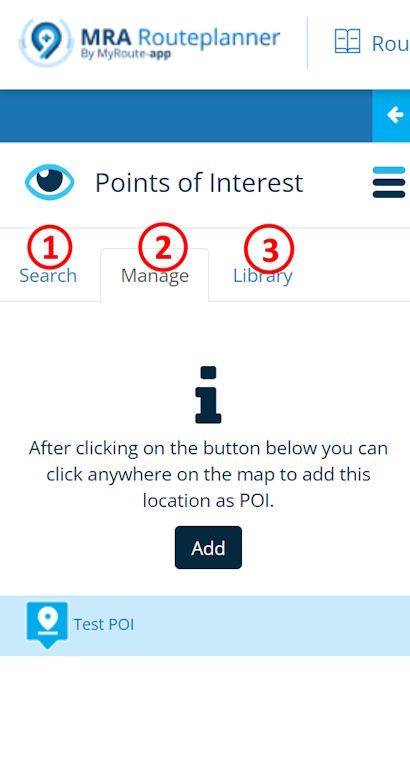
#1 and #3 are like libraries; #1 "search" contains the POIs from the map, and #3 "library" is a private library. These POIs are not directly related to the route but are, so to speak, above it. These libraries also exist in DMD2, one via "search" for the map POIs, and the other via "myLocations" for the private library.
#2 "manage," on the other hand, contains the POIs that are actually assigned to the route, and only these are included in the GPX file as <wpt> when exported.
So if you want to transfer MRA POIs to DMD2 (where they are called waypoints), you have to insert them in tab #3.
-
-
@Martin-Wilcke said in MRA running on DMD:
99% of these misunderstandings come from the different usage of "waypoint" in MRA versus DMD/GPX.
Do you care to explain this difference? What does a waypoint do different in DMD than what it does in MRA? In the end they just shape a route. I think most difference are (just like with any native device) caused by routing settings not being equal between the planner and the device (or DMD software in this case). The beauty of MRA is (amongst others) that a native MRA route applies the planner settings on the navigation app.
@Con-Hennekens said in MRA running on DMD:
Do you care to explain this difference?
Sorry mate, no. We had a long debate on this topic, which I don't want to start over again.
Please take a look at @Guzzist 's excellent summary, where he explains in detail why the term “waypoint” has different meanings in MRA and DMD2/GPX.
-
@Con-Hennekens said in MRA running on DMD:
Do you care to explain this difference?
Sorry mate, no. We had a long debate on this topic, which I don't want to start over again.
Please take a look at @Guzzist 's excellent summary, where he explains in detail why the term “waypoint” has different meanings in MRA and DMD2/GPX.
@Martin-Wilcke, Haha, I did not want to start a flamewar
 I was under the impression that you were referring to technical difference of how waypoints work in each software, but now I understand that it is about a symantec difference. No need for further discussion, I had a few of those on this forum as well...
 I am just an enthusiastic MRA user, and hope you will be one too!
Most motorcycle problems are caused by the nut that connects the handlebar to the saddle.
Check out RideSleepRepeat.eu, a biker community for sharing stays across Europe
-
@Martin-Wilcke, Haha, I did not want to start a flamewar
I was under the impression that you were referring to technical difference of how waypoints work in each software, but now I understand that it is about a symantec difference. No need for further discussion, I had a few of those on this forum as well...
@Con-Hennekens
Yep - it’s all about semantics!
„Waypoint“ is a false friend here and that’s what the confusion is about. -
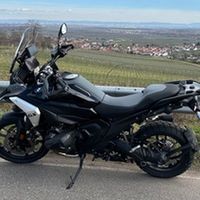
For me it would be interesting to use MRA with DMD Hardware using the BMW Wonderwheel. This would be my favourite equipment for on road navigation, especially of zooming and skipping waypoints is possible…. may be someone has some experiences with this showcase?
-
Excellent summary!
I agree with you 100%, both in terms of the facts and your assessments.
I want to add something about POIs, as they can also easily be confused with DMD2.
In the MRA POI area, we see three tabs, and it is essential to understand that these POIs have different contexts.
#1 and #3 are like libraries; #1 "search" contains the POIs from the map, and #3 "library" is a private library. These POIs are not directly related to the route but are, so to speak, above it. These libraries also exist in DMD2, one via "search" for the map POIs, and the other via "myLocations" for the private library.
#2 "manage," on the other hand, contains the POIs that are actually assigned to the route, and only these are included in the GPX file as <wpt> when exported.
So if you want to transfer MRA POIs to DMD2 (where they are called waypoints), you have to insert them in tab #3.
@Martin-Wilcke ... hi Martin, I'm so sorry about, but that's not 1000% correct

It's so important to talk with correct wording...
If you open a route in MRA (no matter if a new, or existing one), than you can add POI.- by selecting a category from in MRA existing POI list in tab "search"
- or by activating/selecting a imported POI list in tab "Library"
then (if you zoom in the map) you will see many POI about the selected category(s)
then you can click on one or several of those just visible POIs in map, to make them "embedded" in the map -> will be included in an exported gpx file as <wpt>. case#1
and/or you can make them really as route point -> will be included in an exported gpx file as <rtept>. case#2
if you check both checkboxes in the dialog, you will get a route point and a POI. Icons are laying then on each other in map, may you can't see both. - or by creating a POI on the fly by using tab "Manage", clicking button "Add", paning the map and entering so manually a location as POI in the map case#1
- If you close this route and reopen again, the entered POIs case#1 are still visible - on map and on POI list "Manage" in MRA.
But the POIs are - let me say "only aggregated to this route(file)"! Still not part of the calculated route as routepoint! - If you navigate this route by MyRoute-App, entered POI of case#1 will be visible on map too, but you will not be guided to it!
- If you exported the route as gpx file, and imported the file in DMD2, entered POI of case#1 will be visible on map (and GPX-Manager) too, but you will not be guided to it!
- If you navigate this route by MyRoute-App, entered POI of case#2 will be visible on map too, and you will be guided to it!
- If you exported the route as gpx file, and imported the file in DMD2, entered POI of case#2 will be visible on map too, but not in GPX-Manager, and you will not be guided to it!
puhh - I hope, I have described each case, would have nothing overseen, and you can understand my explanations

Nothing is impossible ;-)
In past: GARMIN Zumo 210->GARMIN Zumo 395->GARMIN XT=> now: DMD T865-X + MyRoute-App, LocusMaps, OsmAnd.
In past: GARMIN MapSource ->GARMIN BaseCamp->Tyre->Kurviger->Calimoto=> now: MRA-Routplanner. -
@Martin-Wilcke ... hi Martin, I'm so sorry about, but that's not 1000% correct
It's so important to talk with correct wording...
If you open a route in MRA (no matter if a new, or existing one), than you can add POI.- by selecting a category from in MRA existing POI list in tab "search"
- or by activating/selecting a imported POI list in tab "Library"
then (if you zoom in the map) you will see many POI about the selected category(s)
then you can click on one or several of those just visible POIs in map, to make them "embedded" in the map -> will be included in an exported gpx file as <wpt>. case#1
and/or you can make them really as route point -> will be included in an exported gpx file as <rtept>. case#2
if you check both checkboxes in the dialog, you will get a route point and a POI. Icons are laying then on each other in map, may you can't see both. - or by creating a POI on the fly by using tab "Manage", clicking button "Add", paning the map and entering so manually a location as POI in the map case#1
- If you close this route and reopen again, the entered POIs case#1 are still visible - on map and on POI list "Manage" in MRA.
But the POIs are - let me say "only aggregated to this route(file)"! Still not part of the calculated route as routepoint! - If you navigate this route by MyRoute-App, entered POI of case#1 will be visible on map too, but you will not be guided to it!
- If you exported the route as gpx file, and imported the file in DMD2, entered POI of case#1 will be visible on map (and GPX-Manager) too, but you will not be guided to it!
- If you navigate this route by MyRoute-App, entered POI of case#2 will be visible on map too, and you will be guided to it!
- If you exported the route as gpx file, and imported the file in DMD2, entered POI of case#2 will be visible on map too, but not in GPX-Manager, and you will not be guided to it!
puhh - I hope, I have described each case, would have nothing overseen, and you can understand my explanations
Lots of thoughts - let's sort them out

Firstly, this topic is about "MRA running on DMD", so everything related to "open in MRA" or "run/navigate with MRA" is probably right, I haven't checked, but out of scope here. No offence intended!
My addition to your summary is about "how to create points/items in MRA that show up in DMD as a waypoint (GPX terminology)". There are several ways to do so, right, but either way, we have to make sure they appear in tab #2 ("manage"). All these items, and only these items, are exported as <wpt> and therefore become waypoints in DMD. Do you agree on this?
Rereading my posting, there's a typo in the last sentence:
So if you want to transfer MRA POIs to DMD2 (where they are called waypoints), you have to insert them in tab #3.
That's wrong, I meant: "...you have to insert them in tab #2".
Finally, and this is a common misunderstanding as well, DMD will not "guide" you to waypoints (GPX terminology). You have a line on the map you can follow, and you may get turn-by-turn instructions; however, they will guide you through the route or track, but not to waypoints at all!
Waypoints, on the other hand, are announced, and you'll get the remaining distance to the next one along the route/track, even if they are not precisely located "on the line". But you will not be guided to them; there's no "turn right now", they're just along.To compare this with MRA: You see the line, you get TBTs that guide you from one waypoint (MRA terminology) to another, you get the distance to the next waypoint, and they are announced. POIs, on the other hand, will show up on the map, but there's no guidance to them.
And here's what drives most users crazy: waypoints are announced in both MRA and DMD, and you get the distance to them. It sounds the same, but it refers to entirely different objects! @Con-Hennekens : yes, it's semantics

-
Lots of thoughts - let's sort them out
Firstly, this topic is about "MRA running on DMD", so everything related to "open in MRA" or "run/navigate with MRA" is probably right, I haven't checked, but out of scope here. No offence intended!
My addition to your summary is about "how to create points/items in MRA that show up in DMD as a waypoint (GPX terminology)". There are several ways to do so, right, but either way, we have to make sure they appear in tab #2 ("manage"). All these items, and only these items, are exported as <wpt> and therefore become waypoints in DMD. Do you agree on this?
Rereading my posting, there's a typo in the last sentence:
So if you want to transfer MRA POIs to DMD2 (where they are called waypoints), you have to insert them in tab #3.
That's wrong, I meant: "...you have to insert them in tab #2".
Finally, and this is a common misunderstanding as well, DMD will not "guide" you to waypoints (GPX terminology). You have a line on the map you can follow, and you may get turn-by-turn instructions; however, they will guide you through the route or track, but not to waypoints at all!
Waypoints, on the other hand, are announced, and you'll get the remaining distance to the next one along the route/track, even if they are not precisely located "on the line". But you will not be guided to them; there's no "turn right now", they're just along.To compare this with MRA: You see the line, you get TBTs that guide you from one waypoint (MRA terminology) to another, you get the distance to the next waypoint, and they are announced. POIs, on the other hand, will show up on the map, but there's no guidance to them.
And here's what drives most users crazy: waypoints are announced in both MRA and DMD, and you get the distance to them. It sounds the same, but it refers to entirely different objects! @Con-Hennekens : yes, it's semantics
@Martin-Wilcke fine with you Martin
-
Lots of thoughts - let's sort them out
Firstly, this topic is about "MRA running on DMD", so everything related to "open in MRA" or "run/navigate with MRA" is probably right, I haven't checked, but out of scope here. No offence intended!
My addition to your summary is about "how to create points/items in MRA that show up in DMD as a waypoint (GPX terminology)". There are several ways to do so, right, but either way, we have to make sure they appear in tab #2 ("manage"). All these items, and only these items, are exported as <wpt> and therefore become waypoints in DMD. Do you agree on this?
Rereading my posting, there's a typo in the last sentence:
So if you want to transfer MRA POIs to DMD2 (where they are called waypoints), you have to insert them in tab #3.
That's wrong, I meant: "...you have to insert them in tab #2".
Finally, and this is a common misunderstanding as well, DMD will not "guide" you to waypoints (GPX terminology). You have a line on the map you can follow, and you may get turn-by-turn instructions; however, they will guide you through the route or track, but not to waypoints at all!
Waypoints, on the other hand, are announced, and you'll get the remaining distance to the next one along the route/track, even if they are not precisely located "on the line". But you will not be guided to them; there's no "turn right now", they're just along.To compare this with MRA: You see the line, you get TBTs that guide you from one waypoint (MRA terminology) to another, you get the distance to the next waypoint, and they are announced. POIs, on the other hand, will show up on the map, but there's no guidance to them.
And here's what drives most users crazy: waypoints are announced in both MRA and DMD, and you get the distance to them. It sounds the same, but it refers to entirely different objects! @Con-Hennekens : yes, it's semantics
@Martin-Wilcke, I think the confusion is caused mainly by those who use multiple interpretations in one comment...
If we just call a POI a POI instead of a waypoint, all confusion is gone. I don't know if I understood completely what you said, but POI are never announced in MRA (just to be clear), I do not know if they are announced in DMD.I am just an enthusiastic MRA user, and hope you will be one too!
Most motorcycle problems are caused by the nut that connects the handlebar to the saddle.
Check out RideSleepRepeat.eu, a biker community for sharing stays across Europe
-
@Martin-Wilcke, I think the confusion is caused mainly by those who use multiple interpretations in one comment...
If we just call a POI a POI instead of a waypoint, all confusion is gone. I don't know if I understood completely what you said, but POI are never announced in MRA (just to be clear), I do not know if they are announced in DMD.
@Con-Hennekens said in MRA running on DMD:
@Martin-Wilcke, POI are never announced in MRA (just to be clear), I do not know if they are announced in DMD.
Yep, they are. We’re talking about different concepts here.
And regarding naming: I’d suggest route-waypoint vs POI-waypoint. -
@Con-Hennekens said in MRA running on DMD:
@Martin-Wilcke, POI are never announced in MRA (just to be clear), I do not know if they are announced in DMD.
Yep, they are. We’re talking about different concepts here.
And regarding naming: I’d suggest route-waypoint vs POI-waypoint.
@Martin-Wilcke said in MRA running on DMD:
And regarding naming: I’d suggest route-waypoint vs POI-waypoint.
I will NOT go into this, since I have promised no flamewar earlier...
I am just an enthusiastic MRA user, and hope you will be one too!
Most motorcycle problems are caused by the nut that connects the handlebar to the saddle.
Check out RideSleepRepeat.eu, a biker community for sharing stays across Europe
-
@Martin-Wilcke said in MRA running on DMD:
And regarding naming: I’d suggest route-waypoint vs POI-waypoint.
I will NOT go into this, since I have promised no flamewar earlier...
@Con-Hennekens
It's not about flaming. It's about sharing ideas, thoughts, and opinions about MRA compared to other concepts.
Some users are happy with the navigation ecosystem they are used to, and they are not interested in any other. That's absolutely fine.
But others are. And an increasing number of them are shifting to a workflow where they plan with MRA and navigate with DMD (or at least they are curious about how it works). Most of them are struggling with the different meanings of "waypoint" and "POI" - and there are differences, as @Guzzist and I pointed out.
Simply put, it does not make sense to consistently refer to POIs as POIs and waypoints as waypoints when they have entirely different meanings in different contexts. Why is it so difficult to understand?
-
@Con-Hennekens
It's not about flaming. It's about sharing ideas, thoughts, and opinions about MRA compared to other concepts.
Some users are happy with the navigation ecosystem they are used to, and they are not interested in any other. That's absolutely fine.
But others are. And an increasing number of them are shifting to a workflow where they plan with MRA and navigate with DMD (or at least they are curious about how it works). Most of them are struggling with the different meanings of "waypoint" and "POI" - and there are differences, as @Guzzist and I pointed out.
Simply put, it does not make sense to consistently refer to POIs as POIs and waypoints as waypoints when they have entirely different meanings in different contexts. Why is it so difficult to understand?
@Martin-Wilcke, I have quite a clear understanding of what Waypoints and the different kind of waypoints are, and that is not difficult to understand at all
Hello! It looks like you're interested in this conversation, but you don't have an account yet.
Getting fed up of having to scroll through the same posts each visit? When you register for an account, you'll always come back to exactly where you were before, and choose to be notified of new replies (either via email, or push notification). You'll also be able to save bookmarks and upvote posts to show your appreciation to other community members.
With your input, this post could be even better 💗
Register Login

-
 056
056
-
 05103
05103
-
 19355
19355
-
 0342
0342
-
 0356
0356
-
 0873
0873
-
 02103
02103